OFC Kink Test: A Guide to Cable Durability
How can you guarantee your fiber optic cables will perform flawlessly under extreme physical stress?
Top-tier manufacturers prove it with rigorous mechanical testing. This commitment to quality is what separates a truly reliable product from an expensive field failure.
This article will explain the optical fiber kink test, a critical evaluation for meeting global standards and securing your reputation for producing undeniably fantastic products.
Key Takeaways
- Catching Failures Before They Happen: Severe bends create highly expensive headaches by letting data physically escape the glass core. Finding these faults early completely prevents wallet-draining signal drops hidden inside the plastic jacket.
- Finding the Exact Breaking Point: This specialized stress evaluation forcefully shrinks a cable loop to see exactly when it finally gives up. It perfectly pinpoints the tiniest circle your cords can comfortably handle before folding.
- Satisfying Strict International Rules: To pass the undisputed IEC 60794-1-2 Method E10 benchmark, your cables must survive incredibly tight circles without a single ugly scar, permanent crease, or snapped glass piece.
- Investing in Flawless Accuracy: Putting good money into fully automated, rock-solid gear like the TT-OFCK tester entirely eliminates messy human errors. This hardware ensures your bending numbers are satisfyingly spot on every single time.
Defining the Fiber Optic Kink Test
We describe this as the "how-much-can-this-loop-shrink" challenge. It is a very specific, highly controlled stress evaluation meant to pinpoint the extremely tiny, exact loop size a cord can comfortably handle before it develops a nasty, permanent fold.
When we talk about a "kink," we mean that heart-sinking moment where the outer skin gets a permanent, ugly scar or the delicate glass bits inside get fatally crushed.
From where we sit, this isn't just some casual, everyday bend. It is a forced, continuously shrinking circle that puts serious heat on the cable’s structural design, checking if the outer jacket and the internal strength fibers have the guts to stay perfectly round under intense pressure.
Why Kink Testing is Critically Essential
In heavy-duty commercial applications, ranging from massive telecom towers to aerospace vehicles, cable failure is an absolute nightmare. We maintain that this specific evaluation is the very best way to prove a cord will not quit on you when things get unusually twisty.
1. Identifying Material Vulnerabilities
This test is incredibly great at sniffing out lazy manufacturing. If the jacket is far too stiff or the inner yarns were put in sloppily, the cord will fold way too soon. We see this as a satisfyingly spot on early-warning system for product designs that just fail to meet proper quality benchmarks.
2. Preventing Signal Attenuation
Even if the cord does not fully snap, a bad bend makes the signal light physically escape from the inner glass core. We call this attenuation, but basically, it is just your data escaping the party because the door was left wide open by a sloppy fold.
High-density cables are particularly prone to micro-bending-induced loss under lateral pressure, making specialized evaluations incredibly vital. High-quality diagnostics, like OTDR tools, are constantly used in the field to map these attenuation faults, but finding the breaking point in the lab ensures your data does not vanish into thin air in the first place.
3. Verifying Bend Radius Specifications
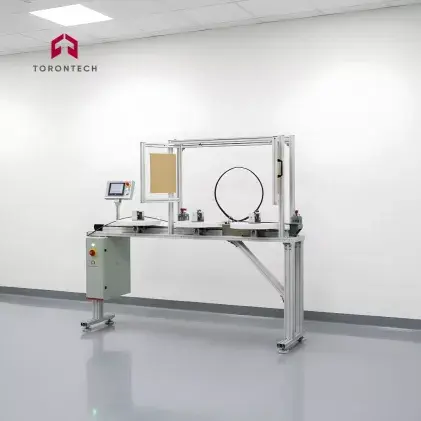
Every single cord comes with a "Minimum Bending Radius" specification printed directly on the box. In our view, the TT-OFCK Series machine is the genuinely perfect way to actually prove that promised number isn't just made up, so field installers know exactly how tight they can turn a corner without ruining the whole setup.
4. Ensuring Long-Term Durability
Little microscopic cracks in the glass or white stress marks on the plastic might not kill the signal today, but they are a silently ticking time bomb. Environmental stresses like temperature, humidity, and chemical exposure cause severe jacket degradation over time. We argue that passing this physical evaluation ensures your cables stay highly functional for years of long service.
Sector-Specific OFC Testing Applications
Since fiber optic lines are appearing absolutely everywhere, we see this "no-kink" rule being a huge deal in some pretty intense spots. The TT-OFCK Series is officially designed to handle demanding cords, including heavily stressed Elevator and Lift Cables, complicated Industrial Cabling, and delicate Aerospace wires.
- Telecommunications: Telecom and specialty fibers demand strict characterization for bending and twist performance. We think this is vital for ensuring incredibly long cords survive being yanked through tight, dirty underground pipes.
- Aerospace, Defense, and Naval: Naval shipboard environments require extensive cyclic flexibility and shock evaluations to survive extremely harsh conditions. Tactical aerospace lines must safely survive being pulled around sharp metal corners in a serious hurry.
- Data Centers: Those server racks are getting insanely crowded. We expect cables to get squeezed into tight, unforgiving metal trays, and they better not choke.
- Civil Engineering: Distributed fiber sensors embedded in concrete require heavy tensile and aging tests to guarantee long-term structural health monitoring.
- Energy and Industrial Power Grids: Optical links in thermal power plants and downhole oil-gas operations require heavy performance verification. For those big outdoor lines getting whipped around by intense winds, we consider structural strength to be totally essential. High-flux solar applications also rely heavily on flawlessly protected fiber performance.
Compliance with IEC 60794-1-2 Method E10
Professional commercial buyers want hard proof. We recognize IEC 60794-1-2 Method E10 as the undisputed heavy-hitter benchmark for this exact test. If a cable sample wants a passing grade in our book, it needs to check these specific boxes:
- No ugly scars or permanent folds on the outer skin.
- The fragile glass fibers inside haven't snapped into broken pieces.
- Any signal loss that happened during the squeeze has to totally disappear once the cord is let go.
To put some real numbers on this, consider a typical cable with a 10-millimeter outer skin. The rules might dictate it has to be forced into a tightening circle as tiny as 200 millimeters across.
If the data signal drops by even a microscopic fraction during that insanely tight squeeze, that entire factory batch gets tossed straight into the garbage.
The TT-OFCK Series Testing Procedure
Getting the numbers satisfyingly spot on is everything here. We are big fans of the automated TT-OFCK Series because the tension application is firm but not outrageously overpowering, so the protective outer jacket is evaluated fairly all the way through. Let's be real: human technicians get extremely tired, and that is exactly when measurements get messy.
- Step 1: Preparation: A piece of cable is chopped and checked to make sure it is completely free of visible defects.
- Step 2: Loop Formation: The cord is turned into a circle and hooked tightly into the mechanical pulling arms.
- Step 3: Stress Application: The machine slowly yanks the ends. We think this incredibly steady, machine-controlled pull is the only genuinely correct way to play by the rules.
- Step 4: Data Tracking: Sensors keep an incredibly close eye on the physical tension and the loop size. We are also big on checking the light signal at the exact same time.
- Step 5: Performance Verdict: If the loop gets small enough without a terrible fold, the resulting pass data is sheer perfection.
Specifications: TT-OFCK Series
We have made sure our Optical Fiber Cable Kink Testing Machine is solidly built with confirmed, factually correct parameters to handle your toughest laboratory demands.
| Feature | Standard Capability Profile |
|---|---|
| Standard | Fully IEC 60794-1-2 Method E10 Compliant |
| Pulling Velocity | Adjustable from 0 up to a speedy 100 mm/s |
| Pulling Head Stroke | Movement range spanning 50 mm to a long 500 mm |
| Safety Cover | Transparent cover measuring 1000 x 700 mm for safe visual monitoring |
| Dimensions & Weight | 2100 x 650 x 1925 mm structure, weighing in at 200kg |
| Storage Temperature | Handles extreme environments from -40 to +60 degrees Celsius (-40 to +140 degrees Fahrenheit) |
| Supported Cable Types | Specially equipped for Elevator and Lift Cables, Industrial Cabling, and Aerospace wires |
Building a Comprehensive OFC Testing Laboratory
While the TT-OFCK Series is a total superstar, we believe it is just one part of the crew.
To really follow the strict global rules, we argue you need a full lineup of physical evaluations. A serious lab should be checking for crushing, hitting, twisting, and stretching too. In our opinion, skipping these other critical tests is just asking for a massive headache down the line.
For instance, a specific cord design might happily survive the tight, shrinking loop of the kink evaluation without a single scratch, but then completely shatter a minute later when you put it into an Optical Fiber Cable Crush & Cut through Testing Machine (like the TT-OFCCC Series) where massive metal weights get dropped straight onto the plastic casing to perfectly meet IEC Method E3/E12.
Evaluating micro-bending sensitivity under lateral pressure is just as critical. That strongly proves exactly why you need the whole gear lineup.
To confidently handle the high stakes of commercial manufacturing, we offer a whole family of Canadian-engineered gear. Whether you are dealing with delicate lines or heavy-duty setups, pulling in equipment like the TT-OFCRB Series Repeated Bending Tester or the TT-OFCTO Series Torsion Tester makes a massive difference.
We have built these things to logically work together beautifully. In our view, getting your whole laboratory setup from one place like Torontech is the absolute smartest way to make sure your data is flawlessly accurate.
Torontech: Your Partner in Cable Reliability
We do not view this bending challenge as a boring daily chore; it is the ultimate safety net.
The engineering behind our equipment is satisfyingly spot on, offering a strong physical pull without being outrageously overpowering, the technical components are rock-solid all the way through, and the structural finish is sheer perfection. We genuinely believe that by putting good money into highly capable, fully automated testing gear, you are fully protecting your brand and making sure your cables are undeniably fantastic.
Ready to beef up your testing laboratory? Explore our full range of Optical Fibre Cable Testing Equipment to find the heavy-duty gear we are most excited about, or Contact Our Experts right now to get a quote for a setup that logically fits your commercial facility perfectly.
References (Click to expand)
- Alj, I., Quiertant, M., Khadour, A., Grando, Q., & Benzarti, K. (2021). Environmental Durability of an Optical Fiber Cable Intended for Distributed Strain Measurements in Concrete Structures. Sensors (Basel, Switzerland), 22.
- Borzycki, K. (2023). Testing of highly doped and photonic crystal optical fibers. Journal of Telecommunications and Information Technology.
- Buranbayeva, А., & Zhussupbekov, A. (2022). Commissioning Test of Distributed fiber-optics sensors during foundation monitoring of the Abu Dhabi Plaza construction project in Nur-Sultan City. Bulletin of L.N. Gumilyov Eurasian National University Technical Science and Technology Series.
- Da Silveira, R., Buras, M., Filho, A., Fernandes, J., & Futai, M. (2025). Laboratory Tests Using Distributed Fiber Optical Sensors for Strain Monitoring. Sensors (Basel, Switzerland), 25.
- Jerez, M., Carballar, A., Conceição, R., & González-Aguilar, J. (2025). Optical Fiber Performance for High Solar Flux Measurements in Concentrating Solar Power Applications. Sensors (Basel, Switzerland), 25.
- Kikuchi, M., Mori, T., Yamada, Y., Sagae, Y., Matsui, T., & Nakajima, K. (2024). A Novel Method for Evaluating Micro-Bending Sensitivity to Ensure Applicability to High-Density Optical Fiber Cable. Journal of Lightwave Technology, 42, 8428-8434.
- Lebduska, R. (1973). Fiber Optic Cable Test Evaluation. 0038.
- Nazarov, A., Ochilov, B., & Khasanov, M. (2021). Performance Characteristics of Fiber Optical Lines and Diagnostic Techniques for Optical Fiber Cable. 2021 International Conference on Information Science and Communications Technologies (ICISCT), 1-5.
- Nurwijaya, M. (2024). ANALISIS GANGGUAN DAN IDENTIFIKASI KABEL FIBER OPTIC MENGGUNAKAN OTDR DI OTB CIREBON-BREBES R4. Jurnal Informatika dan Teknik Elektro Terapan.
- Tomita, N., Takasugi, H., Atobe, N., Nakamura, I., Takaesu, F., & Takashima, S. (1994). Design and performance of a novel automatic fiber line testing system with OTDR for optical subscriber loops. Journal of Lightwave Technology, 12, 717-726.
- Xu, F., Li, L., Jing, P., Yu, Z., Zhang, J., & Liu, S. (2024). Experimental Study on the Characterization of Aging Resistance Properties of Optical Cables in the Hydrogen-Containing Downhole Environment. Sensors (Basel, Switzerland), 24.
- Zhang, F., Zhang, L., & Yang, J. (2020). The Necessity of Testing the Optical Fiber Link in the Distributed Control System. Journal of Physics: Conference Series, 1650.