Disintegration vs Dissolution: A Full Comparison
Let's be direct about what happens after a patient takes a tablet.
A successful therapeutic outcome is a complex process, not a simple one. It depends on a sequence of events, but two of the most critical are disintegration and dissolution.
At Torontech, we see firsthand how getting these steps right is non-negotiable. The success of a formulation hinges on mastering the difference between disintegration and dissolution.
Part 1: Disintegration, The Complete Breakdown

Think of a new tablet as a solid, compressed unit. Disintegration is the demolition phase. It’s the essential first step where the tablet comes into contact with a fluid and begins to break down into smaller granules. This is the first half of the disintegration vs dissolution equation.
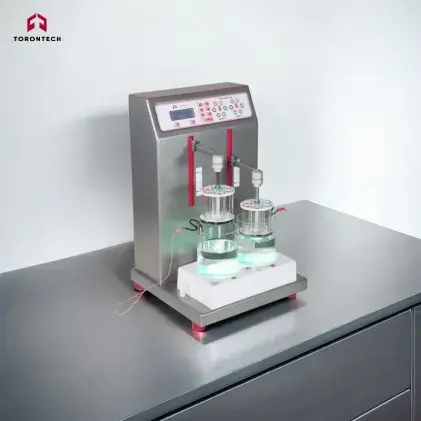
This is a complete physical collapse. Consider an effervescent tablet dropped in water—that immediate, fizzing breakdown is the perfect visual of disintegration. The active ingredient is locked inside, and it can't be released until the tablet structure gives way. The timing of this breakdown is everything, and it’s what our ToronDT series of testers are built to measure with extreme precision.
It's important to know that the ideal timing isn't the same for every product. A tablet for acute pain is formulated to disintegrate within minutes. Conversely, an enteric-coated tablet is designed to be tough, surviving the acidic stomach to only begin its breakdown in the more neutral environment of the intestines.
A few variables can affect the disintegration test:
- Tablet Compression: A highly compressed, hard tablet will naturally take longer to break apart.
- The Excipients: The binding agents and other inactive ingredients in the formula play a huge role in how quickly the tablet structure yields.
Part 2: Dissolution, The Release of the Active Ingredient

So, the tablet has broken down into granules. The job isn't finished. Those granules are still solid.
Dissolution is the vital next stage. It’s when the active pharmaceutical ingredient (API) separates from the granules and dissolves into the surrounding fluid, becoming a bioavailable solution that the body can absorb. This is where the dissolution vs disintegration comparison becomes so clear.
Returning to our effervescent tablet example: after the fizzing stops, the water is cloudy. Dissolution is the process where those suspended particles finally dissolve, creating a clear solution. The active ingredient is now fully released and ready to perform its function.
Frankly, dissolution testing is the best lab-based method for predicting a drug's in-vivo performance. This is why controlling the dissolution rate is so foundational to product development.
An immediate-release (IR) product requires rapid dissolution. In contrast, an extended-release (ER) product is engineered for a slow, controlled dissolution over many hours to provide a sustained therapeutic effect.
What influences the rate of this release?
- API Solubility: The inherent nature of the active ingredient determines how easily it dissolves.
- Particle Size: Smaller particles present a larger surface area, which leads to a faster dissolution rate.
- The API’s Form: The specific crystal structure of the ingredient can significantly impact how quickly it dissolves.
The Core Difference Between Disintegration and Dissolution

| The Lowdown | Disintegration (The Complete Breakdown) | Dissolution (The Release) |
| What it is | The tablet physically breaking into a mess of smaller bits. | The active ingredient melting out of those bits to mix with the liquid. |
| The point | To see how fast a solid tablet can fall apart. | To see how fast the active ingredient is let out and made available. |
| What you get | A pile of tiny particles where a big tablet used to be. | A liquid solution with the active ingredient ready to go. |
| The order | This has to happen first. No breakdown, no release. | Can only begin after the breakdown is well underway. |
Meeting the Official Standards
These tests are governed by strict official standards. Global pharmacopeias, like the United States Pharmacopeia (USP) and the European Pharmacopoeia (EP), provide detailed procedures that clarify the difference between disintegration and dissolution testing. USP <701> covers disintegration, while USP <711> is the key chapter for dissolution. Every piece of our equipment, including the dependable ToronDT-2SA, is built to ensure your results meet these global compliance requirements.
Read more: USP 701 & USP 2040 Disintegration Test Guide
Torontech: Your Partner in Quality Control
You need a partner who understands the stakes. At Torontech, we supply the tools that help you confirm your product quality is exactly where it needs to be. Perhaps you need a compact, single-basket for R&D, or your high-throughput lab requires the fully automated ToronDT-Auto. Whatever your scale, our cost-effective equipment is designed to deliver results you can count on. Getting these two processes right is a massive part of successful drug manufacturing. If you are looking to refine your testing capabilities, have a look at our full lineup of disintegration testers or ask for a personalized quote today. Let's find the proper solution for your lab.
Achieve Consistent Disintegration, Batch After Batch
Explore cost-effective Disintegration Testers for reliable results.