Densitometer vs Density Meter: Which Do You Need?
Getting a handle on the differences between these two tools is the secret to running a high-performance facility. At Torontech, we’ve found that while the names sound like twins, their actual utility in your daily operations couldn't be more different.
Picking the right winner from the start sets your space up for sheer perfection and rock-solid data. In this guide, we are stripping away the fluff to show you exactly which tool fits your needs.
Key Takeaways
- Physical vs. Optical: A density meter measures physical mass and volume, while a densitometer tracks light absorption and visual depth.
- Industry Focus: Density meters are the primary choice for quality control in petrochemicals, food, and pharmaceuticals. Densitometers are the standard for printing, packaging, and photography.
- Smart Procurement: Choosing the correct instrument prevents costly production errors and guarantees your facility consistently meets strict global benchmarks.
What is a Density Meter (Densimeter)?
A densimeter, which most professionals just call a density meter, is the essential high-performance instrument you grab when you need to pin down the physical mass-to-volume ratio or the thickness of a liquid, solid, or gas. In industrial contexts like CO2 capture, these tools are vital for converting volumetric flow to mass flow accurately, often utilizing technologies such as Coriolis meters or gamma-ray densitometers.
We look at these tools as the reliable benchmarks for your facility. They are a total lifesaver for industries where the internal composition and absolute purity of a substance must be watched like a hawk.
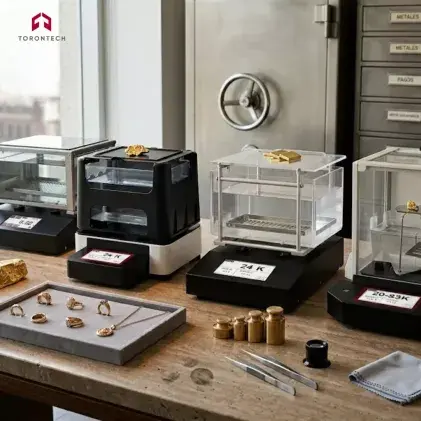
In our book, the newer digital versions that use that oscillating U-tube method, like our Advanced Fully Automatic Digital Density Meter (ToronDDM-90), are the absolute peak of precision. They give you a digital thumbprint of your sample that is satisfyingly spot on.
Where You’ll Utilize These Essential Instruments:
- Drinks and Snacks: Checking the sugar levels in your favorite juice or the concentration in a fresh batch of brew. For instance, a typical commercial brewery relies on this exact tool to lock in the perfect alcohol-by-volume target right before bottling the latest batch.
- Fuel and Oil: Putting crude oil and grease through the wringer to verify their physical weight. Think about a refinery double-checking an incoming shipment with a handheld unit like the Portable Digital Density Meter (ToronDDM-P100) to ensure the oil grade matches the paperwork precisely right on the dock.
- Medicine & Makeup: Making sure the active ingredients in your tablets or creams are exactly as strong as the specs require. A standard pharmaceutical lab uses these readings to guarantee every single cough syrup bottle has the exact same dose.
- Plastic Materials: Measuring how solid and dense those polymer chunks really are. A manufacturing plant, for example, uses a dedicated Rubber, Plastics and Elastic Materials Density Tester on raw plastic pellets before melting them down so the final molded parts never crack under pressure.
Looking for spot-on physical readings? Check out Torontech’s extensive selection of Density Meters, Densimeters, and Specific Gravity Testers.
What is a Densitometer?
Now, while the other instrument is focused on weight and volume, a densitometer is focused entirely on optical density. We have noticed this is where the biggest head-scratcher happens.
Optical density is just a more descriptive way of talking about how much light a material absorbs or allows to pass through. It has zero connection to how heavy your sample feels.
Instead of weighing things, this tool uses a highly calibrated light beam and a sensor. We think these gadgets are the unsung heroes of visual checks; they measure how light zips through clear sheets or bounces off a reflective surface. This process is critical in printing and photography, where quantifying the light absorbed or transmitted through a sample allows for precise material assessment.
Where These Light-Watchers Shine:
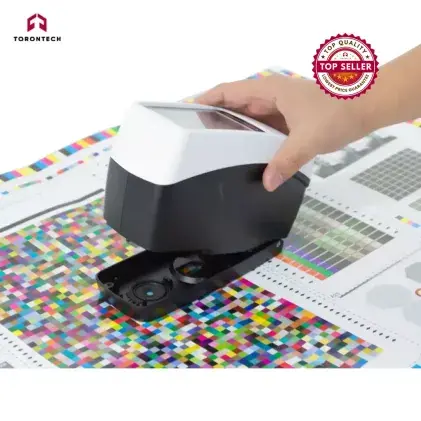
- Printing and Packaging: Keeping an eye on color pop and ink levels so your brand looks sheer perfection every time. Consider a massive packaging facility running visual checks with a flagship tool like our Color Densitometer (TT-Densito528™) to guarantee that a massive run of cereal boxes matches the exact corporate red. Modern units often use spectral reflectance or diffuse densities in different color bands (red, green, and blue) to enable detailed quality assessments.
- Film and Photography: Measuring how dark or light those professional film strips are. Professional studios use this tech to ensure their developed prints have the perfect contrast. Specialized transmission densitometers for color films are particularly valuable for permanence investigations, as they can distinguish the contributions of individual colorants better than monochrome options.
- X-Rays: Checking scans for inconsistencies in metal parts or medical photos. Think about an aerospace manufacturer relying on this optical check to spot microscopic flaws in an airplane wing weld before it ever leaves the hangar.
Densitometer vs Density Meter: The Real Differences
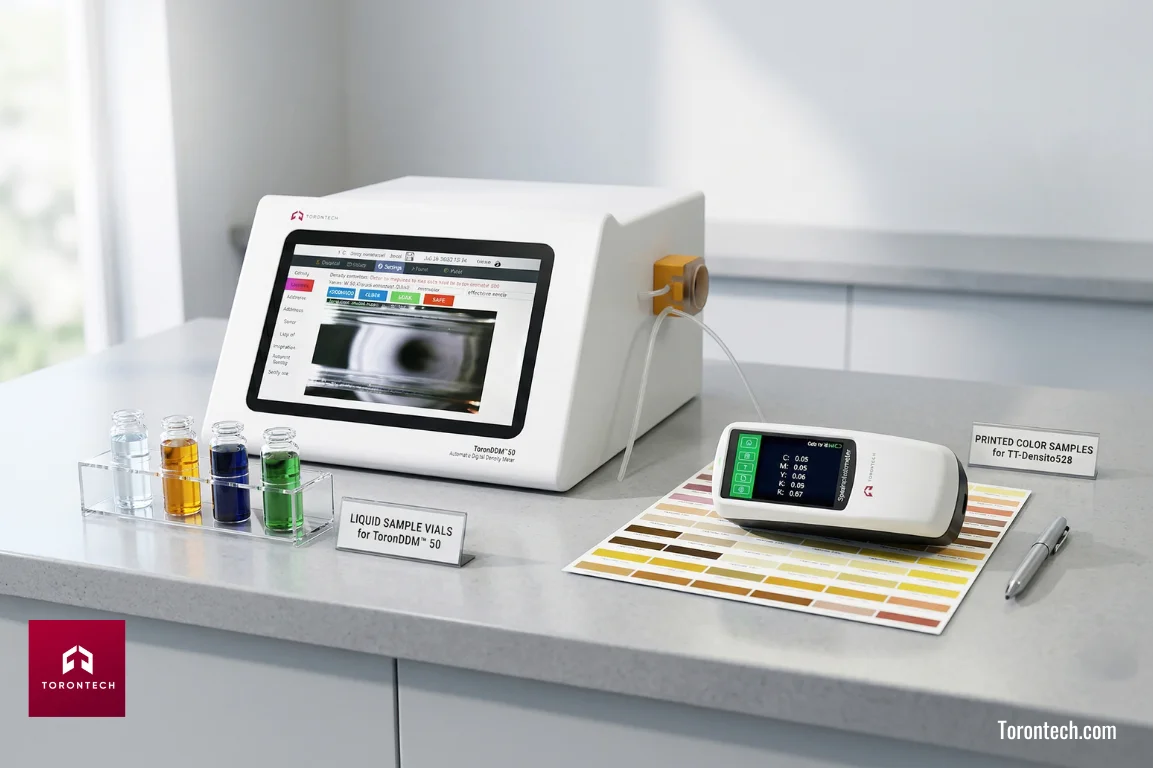
To wrap up this densitometer vs density meter face-off, we have put together this quick cheat sheet so you can spot the difference in a heartbeat. The key distinction lies in their application focus. While density meters broadly measure physical properties like mass per volume, color densitometers are specifically designed to evaluate color quality by measuring specific wavelengths or color channels.
| Metric | Density Meter (Densimeter) | Densitometer |
|---|---|---|
| Primary Measurement | Physical Mass & Volume | Light Absorption (Visual Depth) |
| Operational Principle | Oscillating tubes or buoyancy | Light beams and photoelectric sensors |
| Sample Types | Liquids, solids, air, and powders | Print, film, clear plastic, and X-rays |
| Core Industries | Chemicals, Pharma, Food, and Petroleum | Commercial Print, Packaging, and Radiography |
| The Main Goal | Material purity and composition | Color accuracy and opacity levels |
In our professional opinion, the choice is clear. If you need to know how heavy your sample is for its size, you want a density meter. If you are checking out how light interacts with your surfaces or require a deep analysis of color bands, you want a color densitometer.
What to Look for When Buying: Our Best Advice
Nailing the choice between a densitometer vs density meter is just the start. To make sure your lab stays ahead of the competition, we suggest hunting for these essential features:
Highly Consistent Results
This is the foundation that you cannot skip. You need gear that gives you the same answer every time, even when the factory floor is a high-pressure environment. Consider a busy production line where varying temperatures could throw off basic readings; a top-tier instrument corrects for that automatically so your numbers stay rock solid.
Smart Features & Connectivity
We have seen that modern labs win when data moves fast. Features like snappy touchscreens and easy ways to connect to your local network are essential. Instead of having a technician manually write down hundreds of data points, these setups feed results straight into your central network, totally erasing the chance for typos.
No-Fuss Maintenance
In our view, wasted time is just burning cash. Tools that handle their own calibration save your team a ton of labor and keep your readings steady. A lab running continuous shifts saves hours of downtime simply because the instrument runs its own baseline checks between sample batches.
Cost-Effective Wins
We are firm believers that premium precision shouldn't cost an arm and a leg. Finding that sweet spot between high-end builds and prices that make sense is how you win. A smart procurement team avoids overpaying for flashy, unnecessary extras and instead secures a reliable workhorse that pays for itself in just a few short months.
Meeting Global Industry Rules (ASTM, ISO)
In the B2B sector, we know that being right is only half the battle; you have to follow the rules, too. We have found that the labs that really succeed are the ones that treat these rules as a badge of honor.
For example, we ensure our ToronDDM™ Series density meters play nice with rules like ASTM D4052, while color gear like the TT-Densito528™ stays in line with standards like ISO 5. Here at Torontech, we build our gear to hit or even exceed these global benchmarks, so your facility stays ready for any surprise audits.
Leveling Up with Torontech Today
Selecting the right gear is the very first step in building a quality control setup that stands out as a benchmark for your industry. Whether you need the absolute exactness of mass with a density meter or the light-watching skills of a densitometer, having gear you can trust keeps your business on top.
As a top-tier North American supplier, Torontech delivers cost-effective solutions paired with innovative technologies that respect your budget without ever cutting corners on accuracy. Our team is ready to point you toward a solution that is light on your overhead but heavy on performance.
Ready to make your quality checks better than ever? Take a look at our full stack of Density Meters and Color Densitometers, or give the Torontech crew a shout today for a price that fits your facility perfectly.
References:
- Kenji Ii. (2010). Color densitometer and density measuring method.
- Herrnfeld, F. (1952). Integrating-Type Color Densitometer. Smpte Motion Imaging Journal, 59, 184-190.
- Hofmann, R., Baumann, E., & Hagen, R. (2001). Densitometry versus Colorimetry for Permanence Investigations. NIP & Digital Fabrication Conference.
- MacLeish, K. (1953). Transmission Densitometer for Color Films. Smpte Motion Imaging Journal, 60, 696-708.
- Arellano, Y., Jukes, E., Tjugum, S., & Stang, J. (2025). Experimental evaluation of density meters using liquid CO2 and their effect on volumetric to mass flow conversion for CCS. Flow Measurement and Instrumentation.
- Xu-Xiang, N. (2003). Developing current situation and the trend of color densitometer. Optical Instruments.