
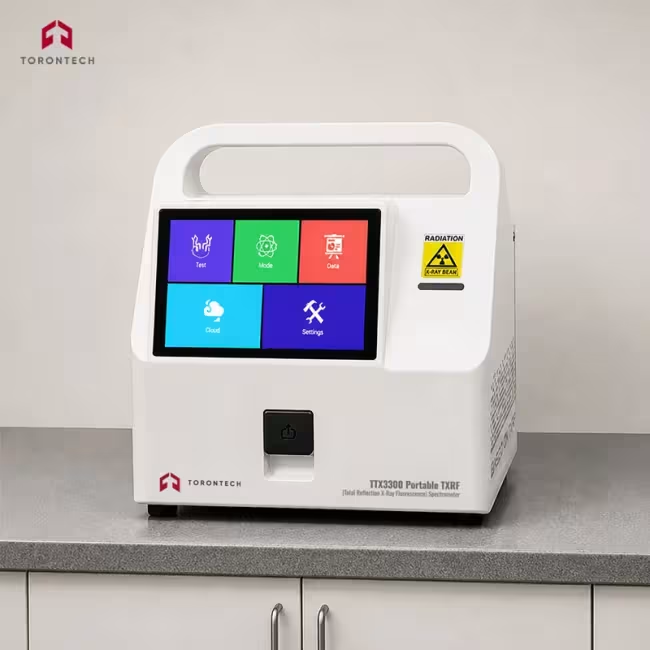
Portable TXRF (Total Reflection X-Ray Fluorescence) Spectrometer
Portable TXRF (Total Reflection X-Ray Fluorescence) Spectrometer – TTX3300
TTX3300 is a portable TXRF spectrometer — a Total Reflection X-Ray Fluorescence (TXRF) instrument developed specifically for rapid, high-sensitivity trace element analysis in field and laboratory environments. Designed after years of accumulated XRF technology development, the TTX3300 TXRF spectrometer delivers extremely low background noise and high signal-to-noise performance by leveraging the principle of total reflection X-rays. The result is a compact, lightweight instrument capable of ppb-level detection without the size, cost, or operational complexity of conventional laboratory-grade spectrometers.
Weighing under 11 kg and housed in a protective carry case, this portable TXRF instrument handles a broad range of sample types (liquids, suspensions, powders, particles, and solid metals) with sample volumes as small as 1 µL. The TTX3300 requires no calibration before each run and no acid digestion of liquid samples, making it one of the most operationally efficient TXRF spectrometers available for on-site analysis, mobile laboratory deployment, and routine quality control workflows.
The TTX3300 TXRF spectrometer integrates a high-brightness micro-focus fixed-target X-ray source, a vacuum orthogonal multilayer reflective focusing optical system, and a large-area Silicon Drift Detector (SDD) — a hardware configuration that supports simultaneous multi-element detection across the Mg–U element range. For organizations that need sub-ppm trace element results quickly and affordably, the TTX3300 offers a compelling alternative to both traditional laboratory TXRF systems and conventional portable XRF analyzers.
Portable TXRF (Total Reflection X-Ray Fluorescence) Spectrometer – TTX3300 Applications
The TTX3300 portable TXRF spectrometer is designed for trace element analysis across a wide range of industries and sample matrices. Its ppb-level sensitivity, rapid sample throughput, and multi-element simultaneous detection capability make it suitable for the following application areas:

Environmental Monitoring
- Surface water, groundwater, and drinking water: trace heavy metal analysis including chromium, lead, arsenic, mercury, and cadmium at regulatory thresholds
- Wastewater and effluent monitoring: industrial discharge compliance testing for trace pollutant elements
- Soil and sediment screening: trace metal contamination mapping for environmental assessment and site remediation
- Atmospheric particulate matter: elemental characterization of airborne particulate samples collected on filters
Food Safety & Agricultural Products
- Beverages, juices, and liquid foods: rapid heavy metal screening (lead, cadmium, arsenic, chromium) for regulatory compliance
- Agricultural products and aquatic products: trace element analysis to verify food safety standards
- Processed food products: detection of potentially harmful elements exceeding permissible limits
Industrial Quality Control & Materials Science
- Semiconductor wafer surface analysis: trace contamination quality control on silicon wafer substrates
- Alloys, ceramics, and glass: trace element composition characterization in advanced materials
- Methanol, ethanol, and alternative fuel quality: trace impurity element quantification to verify fuel specifications and reduce pollutant emissions
Pharmaceutical & Biomedical Analysis
- Pharmaceutical raw materials and finished products: elemental impurity analysis per ICH Q3D guidelines
- Biological fluids and tissue samples: trace element monitoring for clinical and toxicological research
- Cosmetics: heavy metal content screening for lead, mercury, arsenic, and other regulated elements
Forensic Science & Research
- Forensic trace analysis: elemental characterization of hair, fiber, dust, and other trace evidence samples
- Forensic toxicology: toxic element accumulation studies in biological specimens
- Geology and geochemistry — mineral exploration, geological survey, and sedimentary environment research
- Scientific research: trace element studies in academic, government, and industrial research laboratories
Portable TXRF (Total Reflection X-Ray Fluorescence) Spectrometer – TTX3300 Key Features
The TTX3300 TXRF spectrometer is engineered with a combination of advanced hardware, streamlined sample handling, and practical field design that sets it apart from both conventional portable XRF analyzers and traditional laboratory TXRF systems:
- Ultra-Low Detection Limits — Down to ppb Level
- By exploiting total reflection geometry to eliminate substrate scatter, the TTX3300 achieves detection limits at the ppb (µg/L) level — surpassing the detection capability of conventional portable XRF analyzers by orders of magnitude. This makes it effective for trace and ultra-trace element analysis where standard XRF techniques fall short.
- Simultaneous Multi-Element Detection
- The TTX3300 TXRF spectrometer detects up to eight major heavy metal elements simultaneously in standard configuration, including chromium, lead, arsenic, mercury, cadmium, and others. The element range can be expanded to cover nearly 30 elements across the Mg–U range, enabling comprehensive elemental fingerprinting in a single acquisition without sequential element scanning.
- Minimal Sample Volume — µL/ng Level
- The instrument is optimized for sample-limited applications. Liquid and suspension samples require only 1 µL to 50 µL per analysis. Powder samples can be analyzed at as little as 10 µg, and particulate samples up to 100 µm in diameter are accommodated on glass carrier substrates. This low sample consumption is particularly valuable in clinical, forensic, and research applications where sample availability is limited.
- Rapid 2-Minute Analysis Cycle
- A full multi-element analysis is completed in approximately 2 minutes. No pre-run calibration or acid digestion of liquid samples is required, enabling immediate deployment and high sample throughput in field and plant environments. This combination of speed and simplicity makes the TTX3300 highly effective for both routine monitoring and rapid screening workflows.
- Lightweight and Truly Portable
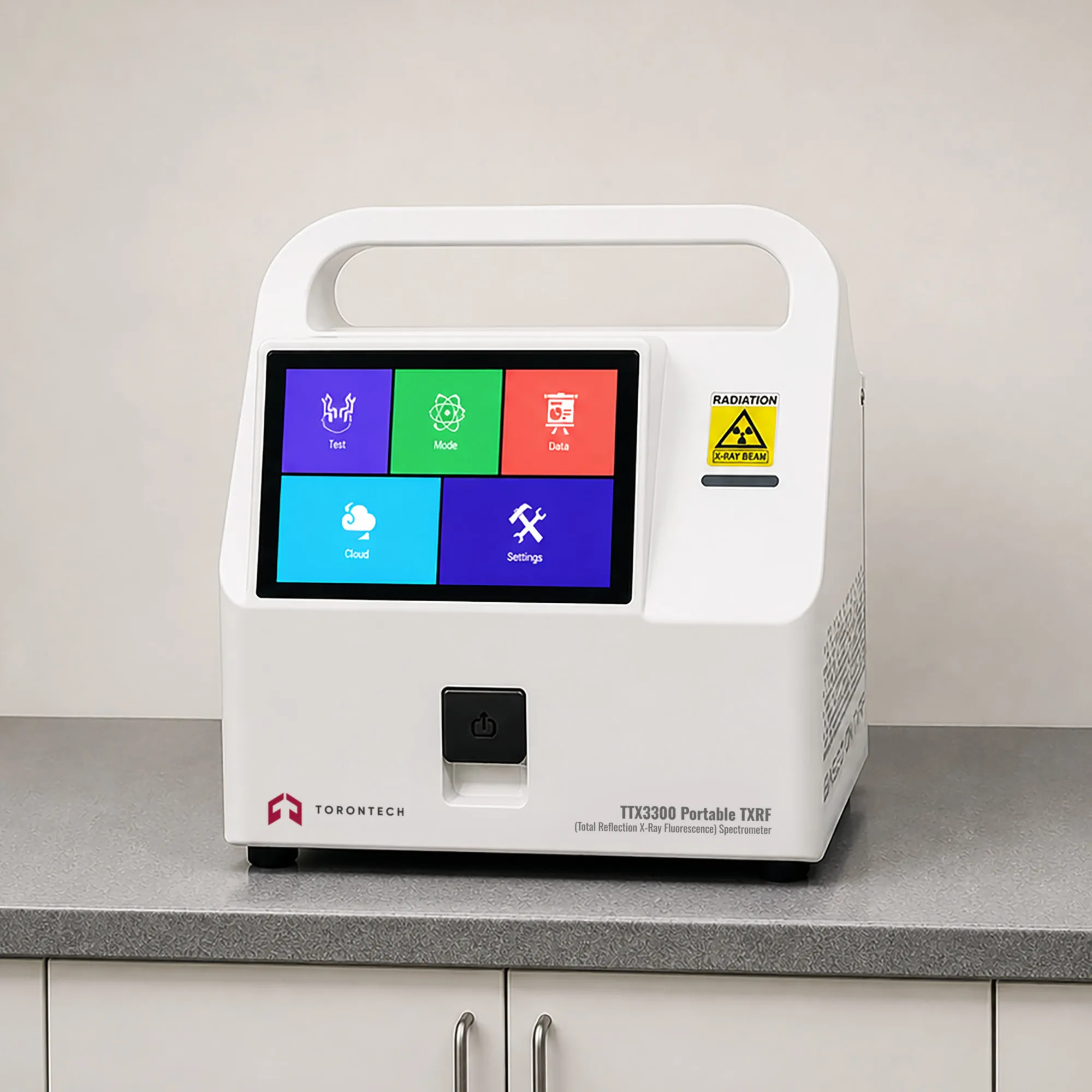
- Weighing under 11 kg (without battery) and dimensioned at 330 mm × 230 mm × 305 mm, the TTX3300 is compact enough for transport to field locations, remote sites, and mobile laboratory setups. It ships with a waterproof, dustproof, and shockproof protective case for safe transport between locations.
- High-Performance Hardware Configuration
- The TTX3300 integrates a high-brightness micro-focus fixed-target X-ray tube, a vacuum orthogonal back-to-back artificial multilayer reflective focusing optical system, and a large-area Silicon Drift Detector (SDD). This combination delivers high photon throughput, low background, and high energy resolution — forming the hardware foundation for ppb-level trace element sensitivity.
- Built-In Industrial Touchscreen Display
- The TTX3300 TXRF spectrometer features an integrated super-large industrial-grade capacitive touchscreen display, allowing operators to view spectra, element results, and instrument status directly on the instrument without requiring a laptop or external monitor. Results can be output via the included Bluetooth printer for immediate on-site reporting.
- Broad Sample Type Compatibility
- The instrument handles liquids, suspensions, powders, particles, and solid metal samples on glass carriers without instrument reconfiguration. This multi-matrix capability makes the TTX3300 suitable for the widest possible range of analytical applications in a single portable TXRF platform.
- Low Operating Cost
- Compared to imported TXRF spectrometers of equivalent performance, the TTX3300 offers a significantly lower acquisition and operating cost. Low sample volume requirements reduce consumption of expensive reagents and standards. The absence of hazardous chemical dissolution procedures for liquid samples lowers operational risk and simplifies compliance with laboratory safety requirements.
- 24/7 Service Support
- Provides a 7-day × 24-hour customer service hotline with fast-response technical support. This service commitment covers instrument operation, application guidance, and ongoing technical assistance to ensure continuous performance and maximum uptime.
Theory and Method
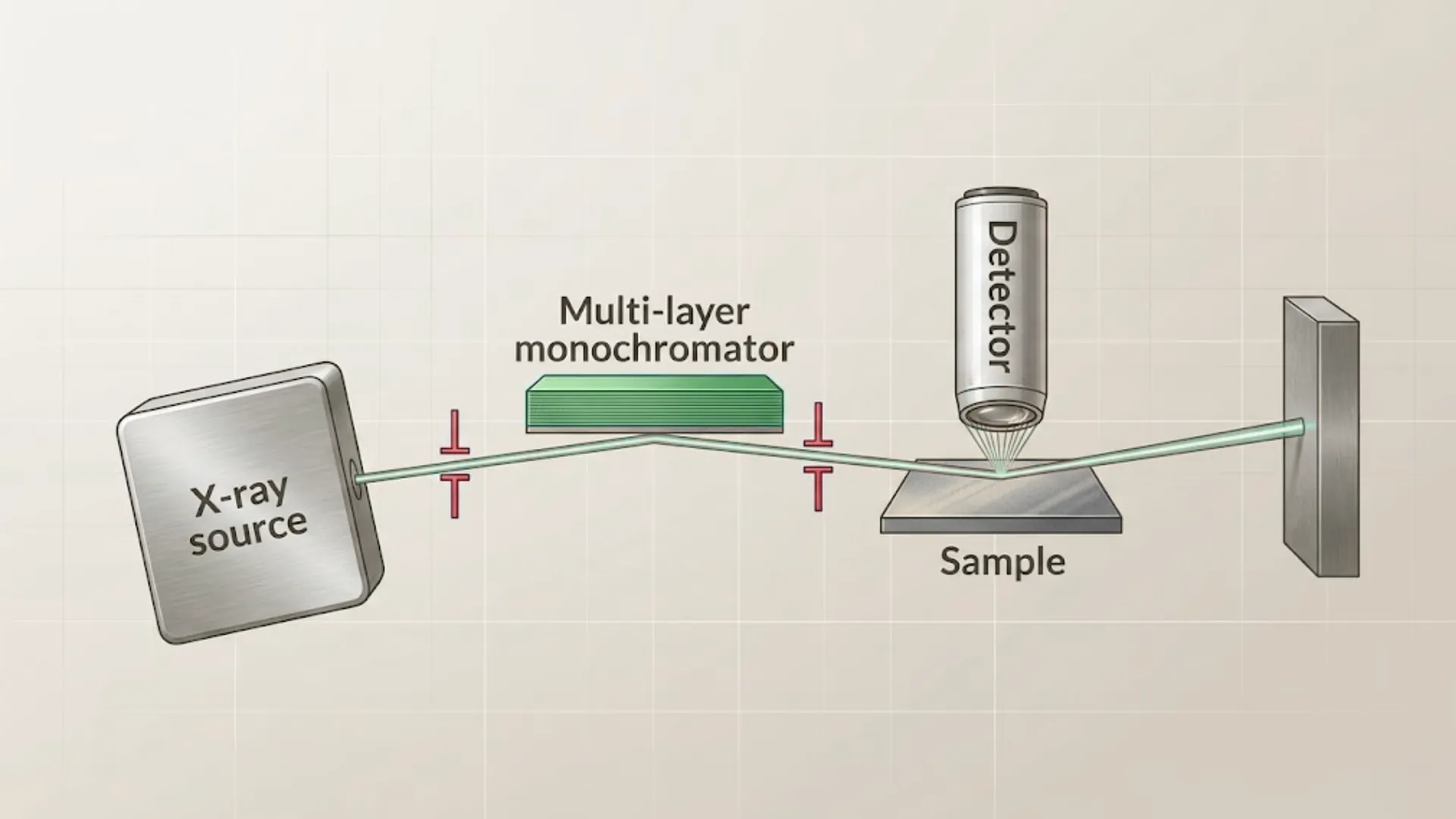
Total Reflection X-Ray Fluorescence (TXRF) is a variant of energy-dispersive X-ray fluorescence spectroscopy that achieves substantially lower background noise — and therefore much higher sensitivity — compared to conventional XRF analysis. In standard XRF, the primary X-ray beam strikes the sample at a relatively steep angle, causing significant scatter that raises the background signal and limits detection thresholds. TXRF eliminates this limitation by delivering the incident beam at an extremely shallow glancing angle, below the critical angle of total external reflection.
At this critical angle, the primary X-ray beam undergoes total reflection at the carrier surface rather than penetrating into it. Only the surface-deposited analyte material interacts with the beam, generating characteristic fluorescence X-rays from the elements present in the sample. Because the substrate contributes virtually no scatter to the detector signal, background noise is reduced by orders of magnitude relative to conventional XRF. This low-background condition is what allows the TTX3300 TXRF spectrometer to achieve detection limits at the ppb (µg/L) level — performance that standard portable XRF analyzers cannot match.
Sample preparation for the TTX3300 is minimal. Liquid samples are pipetted directly onto glass carriers in volumes of 1 µL to 50 µL and dried before analysis. Solid particulate or powder samples up to 10 µg can be deposited on the carrier surface. An internal standard method is available to improve quantitative accuracy across a wide concentration range. Once the sample is loaded, the instrument simultaneously acquires fluorescence signals from all detectable elements, enabling full-spectrum multi-element analysis in a single 2-minute acquisition — with no sequential element scanning required.
Portable TXRF (Total Reflection X-Ray Fluorescence) Spectrometer – TTX3300 Technical Specifications
| Parameter | Specification |
|---|---|
| Model | TTX3300 by Torontech |
| Core Technology | Total Reflection X-Ray Fluorescence (TXRF) |
| Element Range | Mg – U |
| Content Range | 20 ppb – 100 ppm |
| Detection Limit | Down to ppb level |
| Sample Types | Liquids, suspensions, powders, particles, solid metals |
| Sample Volume — Liquids / Suspensions | 1 µL to 50 µL |
| Sample Volume — Powders | Up to 10 µg |
| Sample Volume — Particles | Up to 100 µm diameter |
| Sample Carrier | Glass carriers |
| X-Ray Tube | High-brightness micro-focus fixed-target light source |
| Optical System | Vacuum orthogonal back-to-back artificial multilayer reflective focusing mirror |
| Detector | Large-area Silicon Drift Detector (SDD) |
| Data Display System | Integrated super-large industrial-grade capacitive touchscreen display |
| Standard Analysis Time | Approximately 2 minutes |
| Multi-Element Detection | Up to 8 major heavy metals standard; expandable to ~30 elements |
| Protective Case | Waterproof, dustproof, shockproof carry case (included) |
| Dimensions (L × W × H) | 330 mm × 230 mm × 305 mm |
| Weight | ≤ 11 kg (without battery) |
Standard Accessories
- Main power adapter & cable
- USB 3.0 data cable (1.0 m)
- Bluetooth printer
- Standard solution
- QC standard solution (LBW090104)
- Calibration standard sample
- Sample slides (30/box)
- Sample slide picker
- Adjustable pipette (100–1,000 µL)
Optional Accessories
- Bluetooth printer
- Pipette
- Sampling tubes
- Heating dryer
- Internal standard liquid