
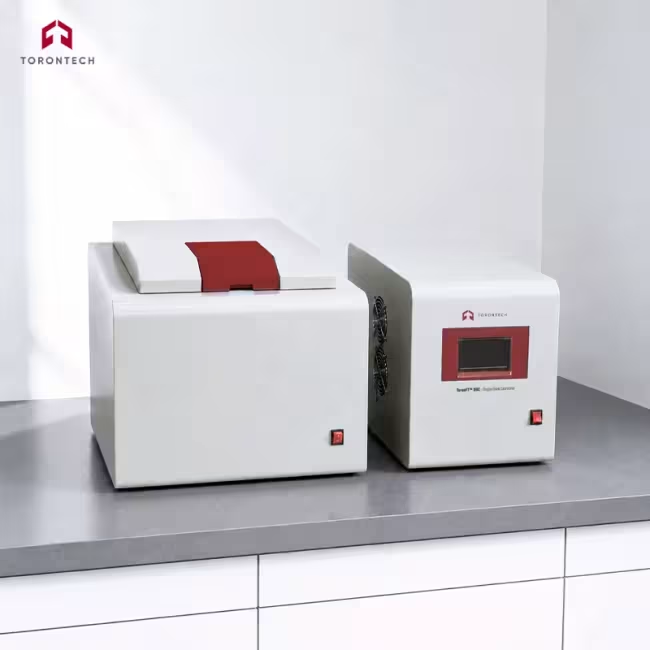
Oxygen Bomb Calorimeter
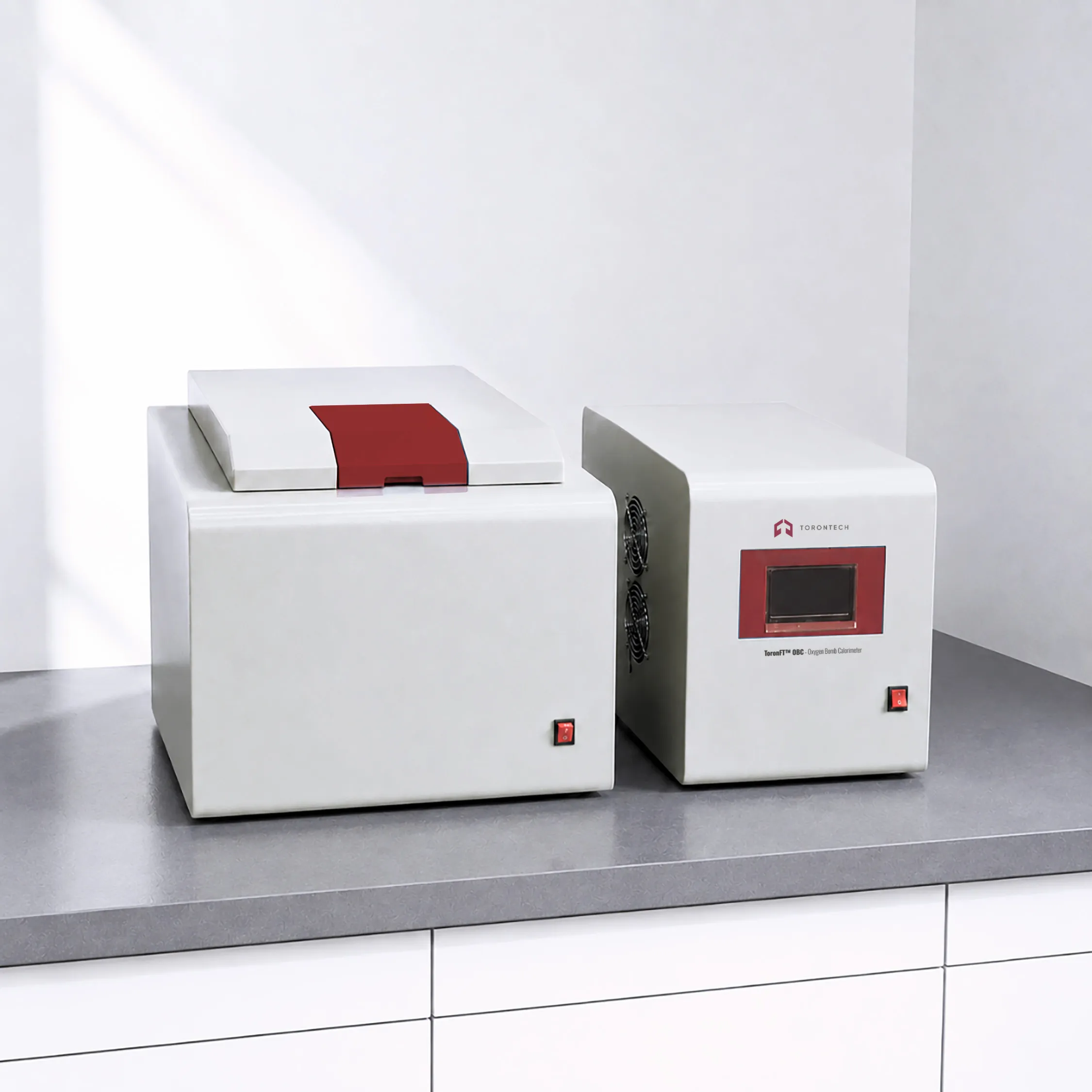
Oxygen Bomb Calorimeter - ToronFT™ OBC
ToronFT™ OBC Oxygen Bomb Calorimeter measures the gross and net calorific value of building materials and products by burning a weighed sample in pure oxygen at constant volume. The heat released raises the temperature of the surrounding water, and the instrument converts that rise into the gross heat of combustion (PCS), then calculates the net value (PCI) automatically. Qualitest supplies the ToronFT™ OBC for laboratories that test to ISO 1716, the method behind the calorific-value limits in the EN 13501-1 reaction-to-fire classification. A PT100 sensor resolving temperature to 0.0001°C lets the calorimeter separate small differences in heat content between materials.
The ToronFT™ OBC runs both adiabatic and isothermal heat systems, and the PC-controlled software reads gross and net calorific value directly without manual calculation. An operator loads the crucible, charges the bomb with oxygen up to 3.5 MPa, fires the sample with a thin iron ignition wire, and the system records the temperature curve and reports the result. Repeatability within 0.1% keeps successive measurements close enough for certification work. The calorimeter covers a wide range, from near-incombustible mineral products up to 30 MJ/kg.
Building-product manufacturers and fire-testing laboratories use the OBC to classify materials and to document compliance. The calorific value is the figure that decides whether a product can reach the top Euroclass ratings, which makes the calorimeter a routine tool in construction-material certification.
Oxygen Bomb Calorimeter - ToronFT™ OBC Applications
The ToronFT™ OBC serves laboratories that classify the fire performance of construction products and other solids by calorific value.
- Euroclass Reaction-to-Fire Testing: gross calorific value measurement for EN 13501-1 Class A1 and A2 classification of construction products
- Building Material Certification: determination of heat of combustion for insulation, boards, panels, and composites
- Incoming Material Screening: calorific-value checks on raw materials and additives that affect a product's fire class
- Research and Product Development: comparison of formulations by heat content to target a lower fire load
- Quality Control: routine verification that production materials stay within their certified calorific limits
- General Calorific Testing: heat-of-combustion measurement of solid fuels, plastics, and other solid samples
Standards
The ToronFT™ OBC follows the bomb-calorimeter method for gross heat of combustion and the classification standard that uses it.
- ISO 1716 - Reaction to fire tests for products: Determination of the gross heat of combustion (calorific value)
- EN ISO 1716 - Reaction to fire tests for products: Determination of the gross heat of combustion (calorific value)
- EN 13501-1 - Fire classification of construction products and building elements: Part 1: Classification using data from reaction to fire tests
Oxygen Bomb Calorimeter - ToronFT™ OBC Key Features
The ToronFT™ OBC combines a constant-volume oxygen bomb with PC control and direct calorific-value reporting.
- Gross and Net Calorific Value: reports PCS and calculates PCI directly, with no manual calculation
- Dual Heat Systems: adiabatic and isothermal modes cover different accuracy and speed needs
- High-Resolution Temperature: PT100 sensor reads to 0.0001°C to capture the small rises from low-energy materials
- Wide Calorific Range: measures from 0.01 up to 30 MJ/kg, spanning near-incombustible to high-energy samples
- Repeatable Results: dynamic repeatability within 0.1% supports certification-grade testing
- High-Pressure Oxygen Bomb: 300 ml bomb charges to 3.5 MPa leak-free for complete combustion
- PC-Controlled Operation: software runs the test, records the temperature curve, and prints the report
- EN 13501-1 Ready: gross calorific value output feeds directly into Euroclass A1 and A2 classification
Theory and Method
A bomb calorimeter measures heat of combustion by burning a sample completely and capturing the heat in a known mass of water. The weighed sample sits in a sealed steel vessel, the bomb, which is charged with oxygen to around 3 MPa so combustion is complete. An iron ignition wire fires the sample, and the burning releases its full heat content into the water around the bomb. Measuring how much the water temperature rises gives the energy released, which divided by the sample mass is the gross heat of combustion.
The gross calorific value (PCS) includes the heat recovered when combustion water vapor condenses, while the net value (PCI) excludes it; ISO 1716 measures the gross value and derives the net value from the sample's hydrogen content. The calorimeter manages heat loss in one of two ways. An adiabatic system keeps the outer jacket at the calorimeter's temperature so no heat escapes, while an isothermal system holds the jacket steady and corrects the small loss mathematically. The OBC offers both, and the software applies the matching calculation automatically.
Accuracy starts with calibration against benzoic acid, a reference material of known calorific value, which fixes the heat capacity of the system. From there the PT100 sensor reading to 0.0001°C lets the calorimeter detect the small temperature rises that low-energy building materials produce. The result matters for classification: EN 13501-1 sets a gross calorific value at or below 2.0 MJ/kg as one of the thresholds for the top Class A1 and A2 ratings. Repeatability within 0.1% keeps a laboratory's results consistent against that limit.
Oxygen Bomb Calorimeter - ToronFT™ OBC Technical Specifications
| Parameter | Specification |
|---|---|
| Method | Constant-volume oxygen bomb calorimeter |
| Compliance | ISO 1716, EN ISO 1716, EN 13501-1 |
| Calorific Value Range | 0.01 to 30 MJ/kg |
| Repeatability | ≤ 0.1% (dynamic) |
| Temperature Measurement Range | 0 to 50°C |
| Temperature Resolution | 0.0001°C (PT100 sensor) |
| Heat Systems | Adiabatic and isothermal |
| Oxygen Bomb Volume | 300 ml |
| Oxygen Bomb Mass | 3.2 kg |
| Oxygen Charging Pressure | 0 to 3.5 MPa, leak-free |
| Inner Cylinder Volume | 2200 ml |
| Ignition Wire | Iron, 0.1 mm diameter |
| Output | Gross (PCS) and net (PCI) calorific value, read directly |
| Control | PC-controlled with report printing |