Planetary Ball Mills for Indonesia's Battery and Minerals Labs
An XRF reading is only as reliable as the powder behind it. When a nickel intermediate or a cathode precursor grinds unevenly, the analysis drifts, and the batch decision drifts with it. Indonesian labs cannot afford that guesswork.
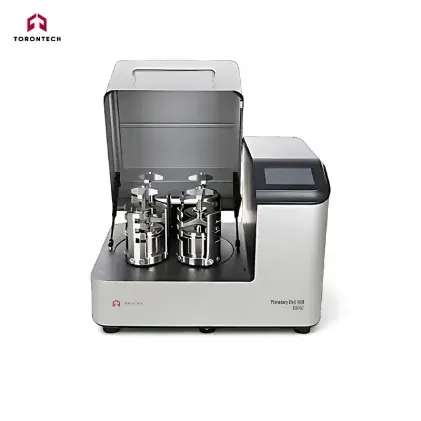
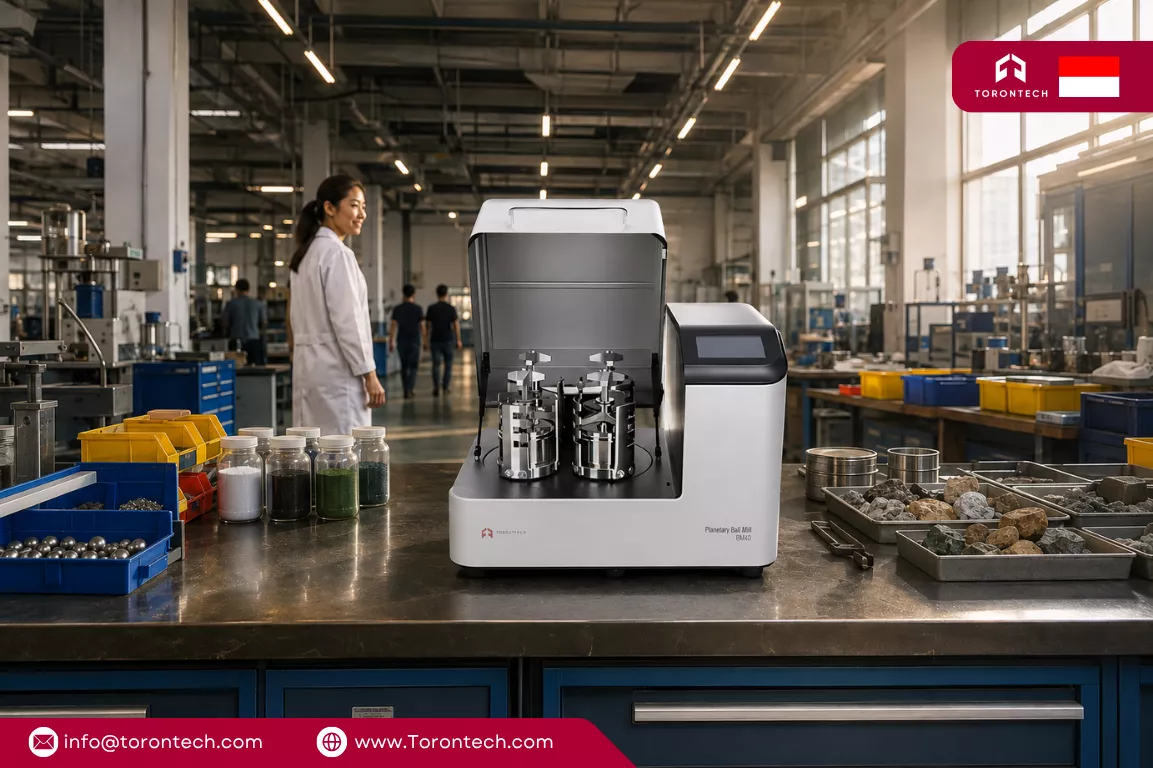
A Planetary Ball Mill in Indonesia gives materials teams the fine, repeatable particle size reduction that downstream analysis demands. Torontech's planetary ball mills grind soft, hard, brittle, and fibrous samples to nano-fineness.
Fine Grinding Behind Indonesia's Downstream Push
Indonesia now processes minerals it once shipped raw. The government's downstreaming program, known locally as hilirisasi, has channeled billions into nickel refining and battery materials, with state vehicle Danantara coordinating a wave of processing projects.
Every stage of that chain depends on fine grinding. Battery researchers mill cathode and precursor powders for particle uniformity. Assay labs pulverize nickel, bauxite, and copper ore before analysis.
Cement and ceramics plants crush clinker and clay for quality control. Homogeneous, finely milled powder is what makes an ore assay or an XRD scan trustworthy.
Common sample streams across these sectors include:
- Battery and electronics: metal oxides, precursor powders, and electrode materials
- Mining and metallurgy: nickel ore, bauxite, copper, gold, and coal
- Building materials: cement clinker, limestone, gypsum, and quartz
- Ceramics and glass: feldspar, clay minerals, glass, and pigments
These are not niche users. Indonesia ranks as Southeast Asia's largest cement producer, and its ceramics sector, grouped under Asaki, is chasing a global top-four position with new industrial zones across Central Java.
Construction demand from the new capital, IKN, and steady infrastructure work keep those quality-control labs busy. For these buyers, a planetary ball mill in Indonesia is a control point for data quality, not a convenience.
Matching Grinding Media and Jars to Your Sample
Grinding media must be harder than the sample, or the media wears and contaminates the batch. That matters most for battery and high-purity work, where trace metal pickup skews every downstream result.
Torontech supplies six jar types across four materials, so buyers can align media to the job:
- Agate: low-contamination grinding for soft to medium-hard samples
- Aluminum oxide: cost-effective for ceramics and general minerals
- Zirconium oxide: tough, low-wear media for battery and electronic materials
- Tungsten carbide: built for the hardest ores and metal oxides
Jar volumes run from 12 ml for scarce research samples up to 4000 ml for pilot batches. The mills handle both wet and dry grinding, and they reach colloidal grinding down to sub-micron and nano-fineness when the application calls for it.
Beyond size reduction, the same platform handles mixing, homogenization, and mechanical alloying. That range supports materials teams developing new battery and electronic compounds, not just routine sample prep.
Choosing a Planetary Ball Mill in Indonesia
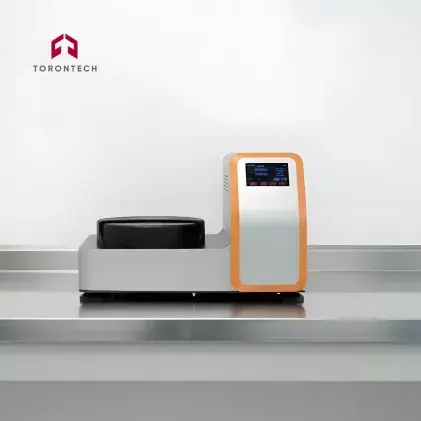
Model choice depends on throughput, feed size, and sample hardness. Torontech's range covers four configurations, from compact benchtop units to high-load platforms.
| Model | Speed | Rated Power | Suited To |
|---|---|---|---|
| BM6Pro | 100 to 650 rpm | 750 W | Compact, high-speed fine grinding |
| BM20 | 50 to 650 rpm | 750 W | Everyday laboratory sample preparation |
| BM40 | 30 to 400 rpm | 1.5 kW | High throughput, up to 8 samples at once |
| BM20Plus | 30 to 300 rpm | 2.2 kW | Coarser feed under 20 mm and heavy loads |
All four run on 220 V, 50/60 Hz power, which matches Indonesia's standard mains supply, with a 110 V option available on request. Automatic direction reversal prevents agglomeration, while programmable time and speed settings keep results consistent across operators and shifts.
Torontech builds the mills for continuous duty with a maintenance-free drive and jar cooling, so a lab running back-to-back batches keeps steady output. Buyers can specify one, two, or four grinding stations to scale sample count to demand.
Compare the full planetary ball mill range to match capacity to your daily workload.
Reproducible Data for SNI ISO/IEC 17025 Laboratories
Indonesian testing labs operate under SNI ISO/IEC 17025, the national adoption of the international laboratory competence standard maintained by BSN. Accreditation comes from the Komite Akreditasi Nasional, or KAN, the sole national accreditation body.
That framework rewards traceable, repeatable methods, and sample preparation is part of the chain. Programmable grinding parameters let a lab document its preparation step and reproduce it batch after batch, which supports the consistency accredited methods require.
Built-in pressure and temperature monitoring records conditions during grinding, giving analysts a data trail for method validation.
KAN accreditation carries international recognition through the ILAC arrangement. Consistent, well-documented grinding therefore helps Indonesian test results reach export partners without repeat analysis, a real advantage for labs serving the mining and battery supply chains.
Configure a Mill for Your Indonesian Application
From cathode research in the battery corridor to clinker control at a cement plant, your grinding step sets the ceiling on data quality. The right mill, media, and jar combination protects every analysis that follows.
Torontech supports customers across Indonesia and the wider APAC region with configuration guidance and grinding media selection. Reach out to the Torontech team to match a planetary ball mill to your samples, throughput, and accreditation goals.