One Number Decides the Batch: Densimeter in Saudi Arabia
A karat dispute at a Jeddah counter. An off-spec blend leaving Yanbu. A resin lot rejected at Jubail before it ever reaches an extruder. Each problem traces back to one unverified number.
That number is density, and a densimeter in Saudi Arabia has to answer for all three sectors. Torontech supplies density meters and specific gravity testers for precious metals, fuels, polymers, ceramics, and sintered parts.
Where a Densimeter in Saudi Arabia Earns Its Place
Four sectors drive demand across the Kingdom. Each one asks a different question of the same measurement principle.
- Gold and precious metals. SASO regulates fineness and hallmarking through accredited assay offices in Riyadh, Jeddah, Dammam, and Al Khobar. Retailers, refiners, and pawn desks verify karat before money changes hands.
- Refining and petrochemicals. Jubail Industrial City hosts more than 350 industrial facilities, while the Yanbu refinery processes 430,000 barrels per day. Aramco and SABIC laboratories check density on feedstocks, blends, and finished product.
- Mining and minerals. Ma'aden works gold, phosphate, aluminum, and industrial minerals as Vision 2030 builds mining into a third economic pillar. Ore, concentrate, and sintered samples all need density figures.
- Plastics, ceramics, and building materials. Converters downstream of SABIC and local ceramic producers use specific gravity to catch filler drift and porosity before parts ship.
Karat Verification for the Kingdom's Gold Trade
Saudi buyers favor 21K and 22K, and the souqs of Al-Balad in Jeddah and Batha in Riyadh move serious volume. SASO Standard 1357:2020 governs hallmarking, so every purity claim must survive scrutiny.
Oversight does not stop there. The Ministry of Commerce and the Ministry of Industry and Mineral Resources both police the precious metals trade, and refiners entering the market under Vision 2030 inherit that scrutiny from day one.
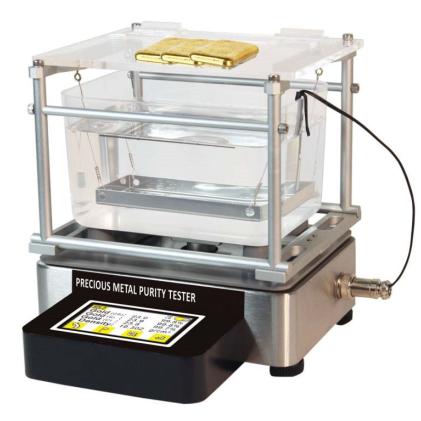
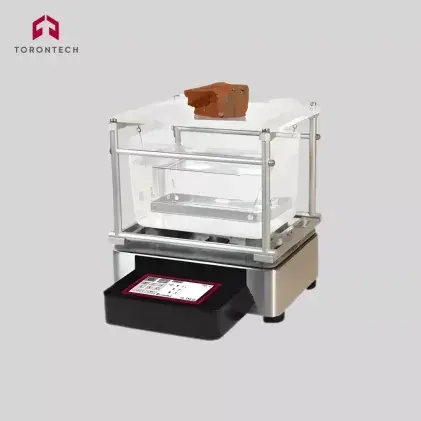
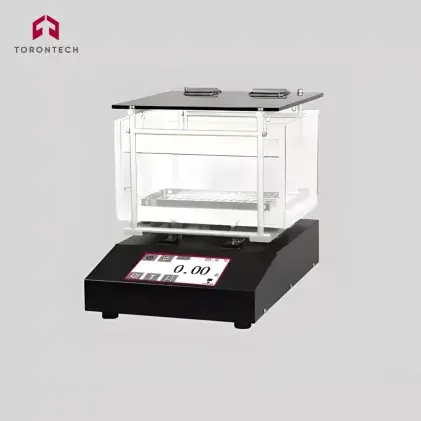
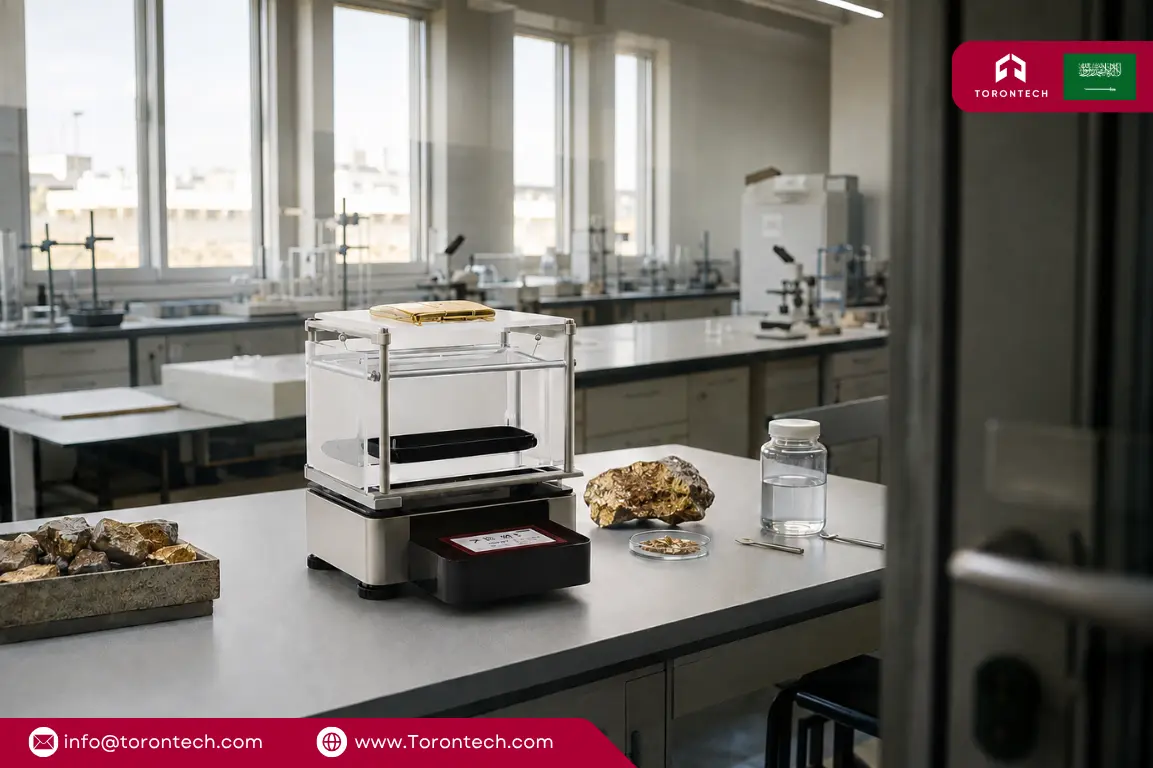
The TTDS-PM-Karat precious metal purity tester applies the Archimedean principle to the whole sample rather than the surface. It reports density, karat, and purity without cutting or dissolving the piece.
Torontech builds this tester in accordance with ASTM D297. Three models cover samples from 5 g to 1,200 g, so one bench handles delicate filigree and bullion bars alike at 0.001 g/cm3 density precision.
Liquid Density for Refining and Petrochemical Labs
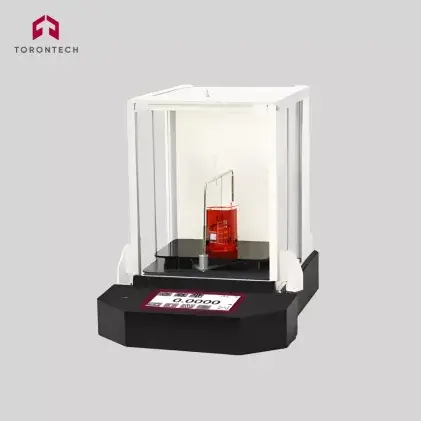
Fuel blending, lubricant formulation, and specialty chemical production all hinge on accurate liquid density. The ToronDDM digital density meter series uses the oscillating U-tube principle with Peltier temperature control.
These analyzers conform to ASTM D4052 along with ASTM D1250, D5002, and D5931, among others. The 70 and 90 models resolve to 0.00001 g/cm3 and support 21 CFR Part 11 audit trails, electronic signatures, and four-level user access.
For tank farms and terminal work, the portable ToronDDM P100 takes handheld density and concentration analysis to the sample instead of the reverse. Torontech lists it as compliant with ASTM D7777-24.
Solids, Sintered Parts, and Mineral Samples
Liquids are only half the picture. Saudi manufacturing generates a steady stream of solid samples that need density figures before anyone signs off on a batch.
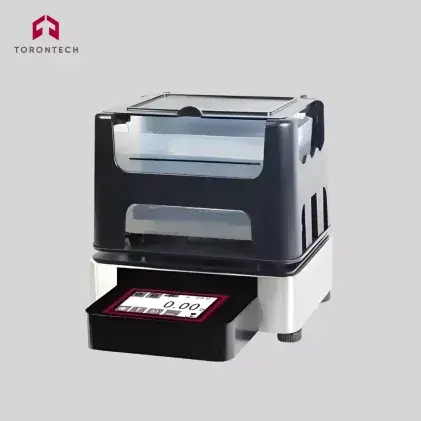
Polymer converters supplying automotive, packaging, and construction customers run specific gravity checks to confirm filler ratios and spot contamination early. Rubber and elastomer producers use the same buoyancy method to verify compound consistency between lots.
Ceramic plants and refractory suppliers track density to control shrinkage and firing quality. In powder metallurgy, density on sintered parts predicts mechanical behavior more reliably than dimensional checks alone.
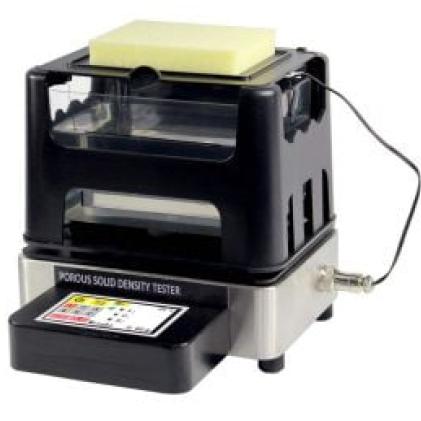
Mining laboratories face a harder case. Porous solids trap air, which skews any straightforward weigh-in-water result. Torontech's porous solid density tester measures bulk density, volume, and porosity, which suits ore samples, kaolin, and mineral-based construction products moving through Ma'aden's supply chain.
Matching the Instrument to Your Material
Start from the material, not the model number. The table below maps common Saudi applications to the measurement approach that fits.
| Material | What You Measure | Typical User |
|---|---|---|
| Gold, silver, platinum | Karat, purity, density | Jewelers, refiners, banks |
| Fuels, lubricants, chemicals | Density, API gravity, concentration | Refinery and petrochemical labs |
| Rubber, plastics, elastomers | Specific gravity, filler content | Polymer converters |
| Ceramics, sintered parts, ores | Bulk density, volume, porosity | Ceramic plants, mining labs |
Beyond material type, four factors usually settle the specification:
- Sample weight range, which sets the balance capacity you need
- Temperature control, critical for volatile liquids and viscous samples
- Porosity handling, since porous solids follow a different workflow than dense alloys
- Data integrity, where audit trails and export formats matter in regulated labs
Specify Your Densimeter With Torontech's GCC Team
Getting instruments into the Kingdom takes more than a purchase order. Imported products move through the SABER platform, and buyers routinely need documentation that satisfies a conformity assessment body before customs release.
Laboratories pursuing ISO/IEC 17025 accreditation carry a further burden: traceable calibration and defensible measurement uncertainty. Torontech supports both fronts, and our regional entity keeps lead times and service response inside the GCC rather than across an ocean.
Tell us your materials, sample sizes, and reporting requirements, and we will configure a densimeter in Saudi Arabia that matches them. Contact the Torontech team or reach Torontech ME FZE directly at +971 488 19252 or me@torontech.com.